Plastic Injection Molding Machine: The beating heart of the mass production industry
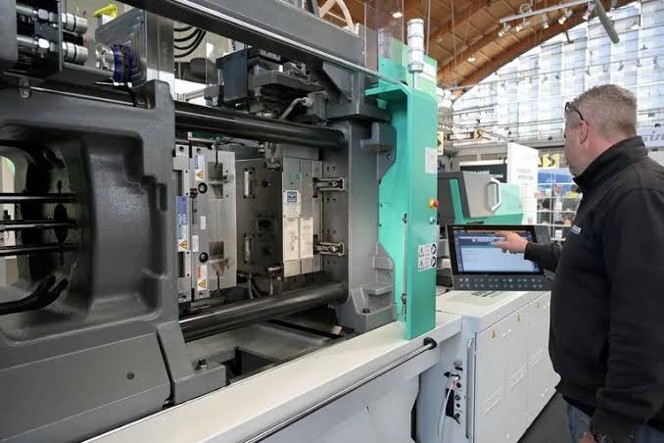
The plastics industry is a mainstay of industrial production in the modern world, and a huge portion of the parts we deal with every day, from water bottle caps and cell phone cases to intricate car dashboards and medical devices, are all the products of an amazing industrial process. At the center of this process is the plastic injection molding machine.
This giant and precise machine, by combining heat, mechanical pressure and hydraulic systems, transforms plastic raw materials into parts with millimeter precision and complex geometry in a matter of seconds.
From raw granules to final pieces
The basic idea of a plastic injection molding machine is to melt solid raw materials (in the form of tiny grains called granules), inject the molten material at very high pressure into a metal mold, and finally cool and eject the solid formed part. This process is carried out in a completely continuous and automatic cycle, and the key to it is precise control of temperature and pressure in a fraction of a second.
Main components of plastic injection molding machine
This industrial machine consists of various parts, each of which has a specific function in the production process, and their coordination ensures the quality of the final part:
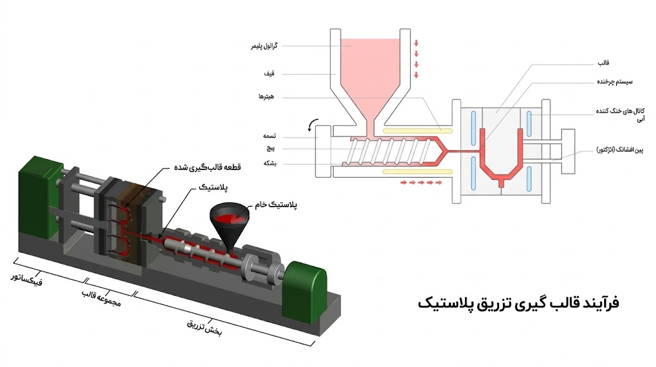
1. Injection Unit: The function of this part is to prepare and melt the plastic and pump it into the mold. Raw granules enter a steel cylinder through a feeding hopper. Inside the cylinder, a screw (screw) is rotating, which, together with the heat of the elements, turns the plastic into a molten and uniform paste.
2. Clamping Unit: When molten plastic enters the mold under intense pressure, a huge force is generated to open the mold halves. The clamping unit is a powerful system that keeps the two mold halves completely locked during the injection process with high tonnage so that the material does not leak out and also prevents the formation of wrinkles.
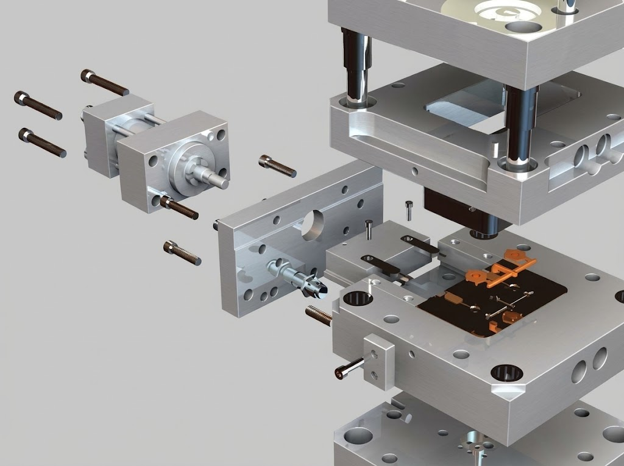
3. Mold: The heart of the part’s shaping, usually made of hardened alloy steels, consists of two halves (fixed and movable) with cavities machined exactly to the shape of the final part.
Performance cycle (production cycle)
The process of producing a part in an injection molding machine is a completely continuous and automatic cycle. This cycle consists of the following sequential steps that are repeated in a fraction of the time:
1. Loading and melting: The rotation of the screw melts the material and collects it in front of the cylinder until the machine is ready for injection.
2. Injection: The screw is pushed forward like a piston and shoots the molten plastic through the nozzle at very high pressure into the mold cavities.
3. Cooling: After the mold is filled, the pressure is maintained for a few seconds to prevent shrinkage of the part. At the same time, cold water flows through the mold walls to solidify the plastic inside the mold.
4. Ejection: The clamp is opened and the ejector pins push the finished part out of the mold. The mold is immediately closed and the next cycle begins.
Industrial applications and benefits
Injection molding machines are the first and unrivaled choice for mass production. Making the mold itself is very expensive and time-consuming, but once the mold is installed on the machine, millions of parts can be produced at a very low cost per unit.
The main advantages of this machine are:
• High production speed: For example, the production cycle of a bottle cap may take less than 3 seconds.
• Accuracy and repeatability: The first part has exactly the same dimensions as the one millionth part.
• Material diversity: Ability to use a variety of polymers (polycarbonate, polyethylene, ABS, etc.) with different physical properties.
• Full automation: The machines can work for hours without the need for direct operator intervention.
Conclusion
The plastic injection molding machine is a clear symbol of engineering at the service of mass production. The complexity of the design of the hydraulic and thermodynamic mechanisms of this machine, along with the ultra-precise machining of the molds, has enabled the cheap, fast and high-quality production of products that our modern lifestyle would be impossible without. Investment in this machinery in the plastics industry continues to be one of the most profitable and sustainable sectors of the manufacturing industry worldwide.